How to Turn Your Primary Home into a Mid-Term Rental (2025)
Today’s I’m giving you an update about our real estate investing journey. More specifically, how we’re turning our primary home into a mid-term rental!
If you follow me on Instagram @financialtherapistlindsey, you’ve seen all the ridiculousness that is our primary home.
With our impending move to Costa Rica, we plan to rent our primary home as a mid-term rental.
What is a Mid-Term Rental?
A mid-term rental is essentially a fully-furnished rental, like an AirBnb, but with stays that are 30-days, maybe 60-days, or even 90-days. Similar to, like, a month-to-month lease.
Why Rent as a Mid-Term Rental?
A question I often get from folks is: “Why do the mid-term rental strategy?”
And we chose the mid-term rental route for several reasons. The primary reason is because we plan to come home from Costa Rica a couple times. And when we do, it’ll be easiest to stay in our own house.
Which means long-term rental, like a 12-month lease, is out of the question. But I don’t love the idea of a ton of turnover with a short-term rental either. Our primary home isn’t in a great location for a short-term rental either. So mid-term rental seemed like the best option.
Who Stays in a Mid-Term Rental?
Now, you might be wondering, “Who the heck wants to stay in a place for 30, 60, or 90 days?”
Well, my dear listener, I will tell you.
Travel Nurses
Travel nurses are the first people who often stay in a mid-term rental. They need to live close to the hospital where they’re contracted. But, on average, those contracts are for 8, 12, or maybe 20 weeks. So they definitely do not want to sign a 12-month lease.
But, in our situation, there aren’t really any big hospital systems near our house in Chaska, Minnesota, so traveling nurses aren’t our specific focus.
Instead there are plenty of other people who might need a mid-term rental including those in seasonal positions like construction workers, truck drivers, or state park workers.
Extended Family
Other people who might want a mid-term rental are extended family members. Maybe you’ve just had a baby or had surgery and family is wanting to come stay near you to help with the new babe or ADLS. Rather than staying with you, your loved one may want their own space. A mid-term rental is great for that. It’s cheaper than a short-term rental or hotel. And they still have a kitchen and lounge area to feel comfortable while helping out.
Digital Nomads
Digital nomads are another group of people who might want a mid-term rental. They work entirely remote jobs and want to explore new places or have been on the road for a while and want a place to temporarily call home until they’re ready for their next adventure.
Home Renovators
Or people who are renovating their home might need a place to stay for a bit. With a home remodel, it’s possible you won’t have a kitchen or bathroom for 45 days while it’s under renovations. Rather than using the one janky bathroom in the basement and trying to cook from a microwave for a month, they might prefer a mid-term rental.
People who have been Displaced
Finally – and this is a demographic I would love to help – are families who have been displaced from their home for one reason or another. For example, this might be because their home was burned down in a fire. Insurance agencies will actually pay for temporary housing. And I think the idea of making our home available and comfortable for a family who needs the space is a really beautiful thing.
All that to say, there are a ton of reasons why someone might want or need to stay in a place month-to-month, so that’s what we’re planning to do.
Getting a Mid-Term Rental Ready
I’m going to give you a rundown of all the things we’ve been doing to get the house rental ready (and frankly, there’s been some deferred maintenance on our house that needed to be taken care of).
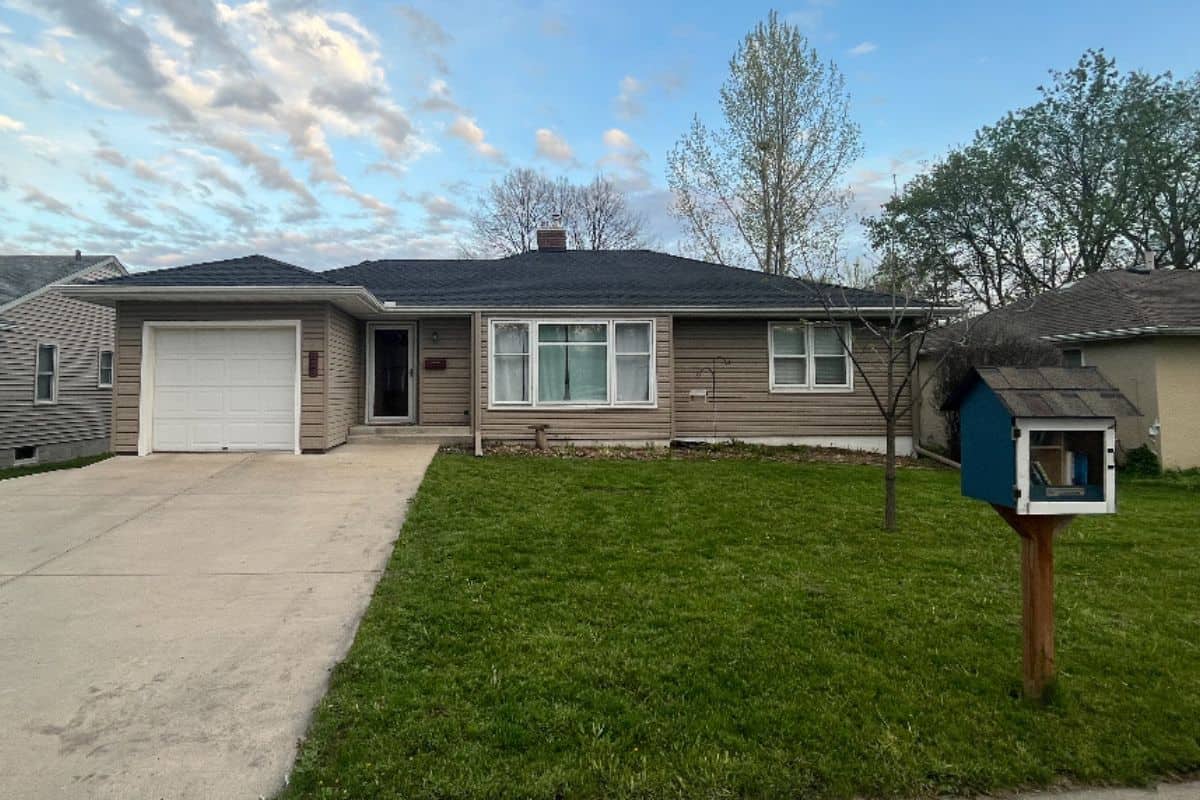
But before I do, I want you to try and picture our house. We don’t live in a new build or a fancy, Pinterest-perfect, Instagrammable home. It’s a 1950’s rambler-style lil’ cutie.
Sometime after the home was built, the previous owner lifted the entire house by three cinder blocks, so the basement ceilings are about 9 feet high. When we bought it in 2016, the entire basement was unfinished with just a random janky toilet and shower in the middle of the space. Both in working condition, but super weird to use.
Our house has a detached two and a half stall garage in the back with its own driveway to a paved alley.
But the previous owner also spruced up the top floor by adding a one stall attached garage and mudroom that leads to a nice, big deck on the back of the house.
When we bought the house, it was all one-level living. The washer and dryer are on the main level, next to the dining room and there are two bedrooms and a full bath on the main floor as well.
Since moving in, we’ve done a fair amount to the house. During Covid, we put in a line of arborvitae trees to act as a privacy fence from our weird neighbors and their crazy dogs. And poured a cement pad to eventually (hopefully) get a hot tub.
Then, two years ago, we framed in the entire basement and finished our primary bedroom, which is more than double the size of the smaller bedrooms upstairs. We also moved the laundry downstairs and turned the original laundry closet into a large pantry. Last year, after hail damage, we got a new roof. And at the end of 2024, our water heater decided to give out, so that’s been updated, too.
Since we made the decision to make this an MTR, there was a lot I wanted to do to bring the property up to snuff. So this is what we’ve done in the last few months. And I’ll give you a cost breakdown of it all!
- We redid the upstairs bathroom. Everything in there is new except a new tub and shower. So new floors, new paint, new toilet, new vanity, new shelves, and new hardware.
- Then, while laying the transition board from our bathroom to the hallway, AJ lifted our dingy old carpet only to find beautiful hardwood flooring which we uncovered in our hallway and both of the main floor bedrooms. We have since taken up all the carpet, got the original hardwood flooring resurfaced and added real hardwood floors throughout our living room and mudroom. We toyed with the idea of taking up all the tile in the kitchen and dining room, but it would have been an additional $7-grand and we opted to leave the perfectly fine, albeit a little ugly, tile as is.
- Because we ripped up the carpet and added the new hardwood floors, we decided it was time to take down the front hall closet, which made the whole house feel closed off and sad. So we demo’d that and took up all the old 70’s style brown tile, which was soooo ugly.
- Because we took the front hall closet out, we lacked storage space for jackets, hats, mittens, and shoes. So we put built-in lockers in the mudroom.
- Meanwhile, we didn’t have enough going on at this point (she says facetiously), so I figured we should add some stellar landscaping to our backyard. See, years ago, we had a cement pad poured. I’ve dreamt of having a hot tub for decades. But we never ended up doing anything with a cement slab. I wanted to make it more functional so I decided to take a shovel and make a paver path from the bottom of our deck stairs, across the backyard to the cement pad where we’ll add a cute little seating area for our residents.
- With the ADHD brain that I have, I’m really good at starting things and then never finishing them. So we paused the landscaping to head back inside and redo all the trim and some of the casing around our windows and doors.
- We also replaced the glass in our giant, 11-foot long living room window
- Now, we’re in the process of re-doing the dining room walls because no one ever sealed or primed the plastic, and parts of the paint were starting to lift. (I’d highly recommend you go to my Instagram to see the video of me doing this without talking to AJ first.)
- Next, we’ll need to replace the windows pretty much all around the house.
- Finally, we’ll need to touch up the paint and furnish it to make it feel cohesive and cozy for future residents!
And I think – maybe, just maybe, we will be done at that point. If I’ve learned anything about home renovations, it’s that they never end. We could be working on this project endlessly for the rest of time, buuut we’re going to try and stop there.
Mid-Term Rental: Renovation Costs
So how much has all this cost? Lucky for you, I track my spending in my Intentional Spending Planner, and I know damn near down to the dollar how much this project has cost.
Bathroom: $800
Hardwoods: $7,500
Closet demo: $325 (We hired someone to take the trash)
New Trim: $$1500
Lockers: $500
Landscaping: $450
Glass replacement:$855
Dining room walls: $300
Furniture: $1,200 (couch, coffee table, mirror, shelves, ottomans, baskets)
The grand total of what we have spent so far is (drum roll, please): $13,430
We do need to finish a few more things like new windows. We were quoted an insane number for those. So we’re contemplating doing them ourselves. TBD. And then there is still touch-up and more furniture and decor needed. Which I’m planning to spend less than $1,500 on all that. We’ve done a really good job of buying most things secondhand, which is something I value. So I’m proud of that!
All in, I’m guessing we’ll be sitting at about $20,000 of improvements this year.
Does everyone need to do this in the event of turning their primary home into a mid-term rental? Obviously not. But as I said at the beginning of this episode, we had been wanting to make a lot of these changes regardless. And because it is a very real possibility that we will come back to this house post-Costa Rica living, we chose to make it the way we wanted.
That’s all the tangible things I’ve been doing to make our house rental ready, but there is more behind the scenes stuff that I’ve been working on to feel confident in this process.
Mid-Term Rental: Next Steps
After the house is completely put back together and furnished, it’ll be time to take pictures, list and market the house, create a vetting process, write up a lease agreement, and put together my team. Because I haven’t done any of that yet, I’m no expert on it. So take this all with a grain of salt.
If you’re new here, you’ll learn quickly that I tend to build the plane as I’m flying it. And you’re along for the ride.
Hire a Real Estate Photographer
I’m hoping to hire a real estate photographer in about a month. We need to have professional photos of our house to ensure the listing looks nice and, well, professional.
List the House on Furnished Finder
Then, I’ll post the listing on Furnished Finder, which is essentially an app like AirBnb, but it’s specifically for furnished rentals that are 30 days or more. This is where the people I just mentioned – travel nurses, construction workers, extended family members, digital nomads – are all finding furnished homes.
I may list it on AirBnb as well, but prohibit anyone from staying less than 30 days. I’m still playing with this idea.
Market our Mid-Term Rental
Next, I’ll market it. While sites like Furnished Finder and AirBnb are great, they don’t do my job for me. I still need to market the house and make sure people know about it.
The primary way I intend to market the house is by going to local insurance agencies and letting them know we are open to housing people who have been displaced. Like I said earlier, I would rather open my home to a person or family in need of a space rather than them having to go to a janky extended stay hotel.
Beyond that, I’ll connect with local real estate agents who have clients that are moving to MN from out of state and need a place to stay while they search for a home. And I’ll use social media to get the word out!
Create a Vetting Process
Perhaps the most important step is the next one, which is creating a thorough vetting process. It’s important that we have people in our home that are going to take care of it. So, just like you vet a tenant for a long-term lease, you do the same for an MTR. This includes things like:
- Creating an application
- Interviewing the person or people
- Checking credit, income, and criminal and eviction history,
- And contacting previous landlords for references
Honestly, I’m a little nervous about this process. I’ve never placed a tenant before. Even with our small multi-family long-term rental, we inherited the residents and honestly hit the jackpot. They are both incredible. Not only are they kind and care about our property, but they take care of it and pay rent on-time or early each month.
Most people I have talked to that have mid-term rentals have had an absolutely wonderful experience. In fact, I’ve only heard of one bad experience. But still, I’m new at this. So, we’ll see how it goes!
Write a Lease Agreement
Once all that is done, I’ll work on writing up a lease. This shouldn’t take too much time because of tools that are available, but there are certain provisions we’ll add – such as the residents won’t have access to our second driveway and detached garage. This goes without saying, but I want to make sure that we’re protected and that they know the rules and expectations of our home.
Hire a Team
Last, but certainly not least, I’ll put together a team. This will include a cleaner, lawn care and snow removal, and perhaps, a property manager.
The Wrap Up: Turning Our Home into a Mid-Term Rental
As a reminder, this process is not linear. I’ll likely be putting my team together while I’m creating a standard operating procedure (SOP) for vetting a future resident while also marketing the place.
As a mom and owner of several businesses now, I have to lean into whatever I have time for and sometimes that’s filling in a 30-minute gap in my day with writing a lease agreement and other times I have a two hour window where I can actually go to an insurance agency, have a chat, and give them some business cards.
But if you’re interested in doing something like this, my top tangible advice is to learn and network. That’s step one. Always. There are so many free or inexpensive resources out there. Podcasts, books, blogs. Start there. Learn about real estate investing and how it can support your dreams.
Stay tuned for more updates on our real estate investing journey!
Read next: Real Estate Investing: 5 Mistakes We Made (Part 2)